This post first appeared in the Mercury News
Now that winter is approaching, it’s time to think about your home heating system. If every room in your house is nice and cozy and your heating bills are reasonable, you can skip today’s column or pass it along to someone who is shivering. But if part of your house is too cold or you’re concerned about energy consumption, I have some suggestions.
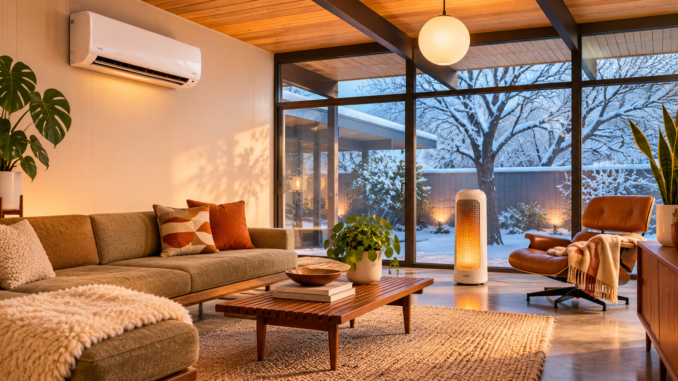
A couple of years ago, I replaced our 70-year-old gas-fired radiant heating system with a Mitsubishi electric heat pump and mini-split units. Our radiant system, typical of Eichler homes, did a good job of heating our first floor by circulating hot water through pipes embedded in the concrete slab foundation.
My main complaint was that unless I left it running overnight, it took hours for the house to reach a comfortable temperature. It also relied on natural gas, a fossil fuel that contributes to climate change that my city is trying to phase out. Our heating costs are now a bit lower, and since we no longer have gas appliances, we’ve had our gas meter removed, eliminating monthly fixed charges.
Heat pump advantages
One advantage of heat pumps is that the same system that heats your house in winter can cool it in summer. In winter, a heat pump extracts heat from outdoor air and transfers it indoors, even when it’s cold outside. In summer, it removes heat from inside your house and transfers it outdoors.
As a longtime Bay Area resident, I never felt we needed air conditioning. But after experiencing extreme heat and wildfire smoke in 2017 and especially in 2020, what once seemed unnecessary began to feel like a necessity. On hot, smoky days, opening windows was no longer a good option.
Also, ductless mini-split units eliminate the need for conventional ductwork and let you independently control temperatures in different parts of your house.
These systems can also be remarkably quiet. According to Mitsubishi’s specifications, our bedroom units operate at between 19 and 43 decibels, depending on fan speed, while our larger living room unit operates at between 28 and 48 decibels when heating. At their lowest settings, they’re nearly silent. Our outdoor unit is rated at 56 decibels, quieter than a typical conversation. Neither we nor our neighbors are bothered by its noise.
Drawbacks and costs
Drawbacks include potentially higher installation costs and reduced efficiency as outdoor temperatures drop, although heat pumps designed for colder climates can operate well below freezing. Depending on local energy rates, a heat pump isn’t necessarily cheaper to operate than a gas furnace. You may also need multiple indoor units, and there’s the aesthetic issue of having relatively large units mounted on your walls.
Our two 9,000 BTU bedroom units are more than adequate, but because much of our house has an open floor plan, the single 18,000 BTU living room unit isn’t quite up to the task on colder days. It’s important to properly size and position units based on your home’s layout, square footage and insulation. In June 2024, we paid about $17,000 for a Mitsubishi 36,000 BTU multi-zone heat pump and our three wall-mounted indoor units, including installation. I wouldn’t be surprised if prices are higher now.
Do shop around. We got three bids and went with San Jose-based Calvey Heating & Air, whose bid was substantially less than that of a contractor referred by Costco for an equivalent system. We were very pleased with the equipment and installation. One thing I’ve learned in more than 40 years of reviewing technology is that the most expensive option isn’t necessarily the best. Read customer reviews, ask friends and neighbors for recommendations, and check contractors’ licensing, insurance and warranty terms.
Whatever heat pump system you buy, I highly recommend connecting it to Wi-Fi so you can control it with an app or your voice, easily set schedules and adjust the temperature even when you’re away from home. Some systems have built-in Wi-Fi, but adding that capability can cost extra. An economical alternative for mini-split units with infrared remote controls is to purchase smart controllers from companies such as Sensibo or Cielo. These devices connect to your home’s Wi-Fi network and communicate with your heating and cooling units using the same infrared signals as their handheld remotes. Both companies offer smartphone apps and support for Amazon Alexa, Google Assistant and Apple Siri.
Before buying a heat pump, check for rebates and tax incentives. Palo Alto, for example, offers a $2,500 rebate for replacing a gas heating system with an electric heat pump and $5,000 for income-eligible households. Other Bay Area electricity providers, including Silicon Valley Clean Energy, also offer incentives. Although the federal tax credit of up to $2,000 for qualifying heat pumps expired at the end of 2025, other rebates remain available, some based on household income. You can find links to rebates at larrysworld.com/rebates.
When space heaters make sense
To save money, we didn’t install mini-split units in several smaller rooms, relying instead on inexpensive electric space heaters. Although space heaters use considerably more electricity than heat pumps to produce the same amount of heat, we don’t occupy these rooms all day. It could take many years for energy savings to offset the cost of installing additional mini-split units.
The most recent space heater I’ve been testing is the $80 Lasko AR122 ThermaSMART ceramic tower heater, which the company provided for review. It’s a 22-inch, 1,500-watt heater controllable from its front panel, a smartphone app or via Alexa or Google Assistant. It has three heat settings, an adjustable thermostat, oscillation and occupancy detection technology that can shut off the heater when no one is present.
Unlike our mini-split units, which take a few minutes to start emitting heat, the Lasko provides almost instant warmth. It’s more than adequate for a small room and can provide localized warmth in a larger room if you’re sitting relatively close.
Limitations of smart space heaters
To comply with UL 1278, a safety standard for electric heaters, Lasko disables Wi-Fi control if the heater is moved, someone presses one of its physical buttons or it hasn’t received an app command for 24 hours. You must physically press its Wi-Fi button to restore those capabilities. I didn’t encounter these restrictions with some older Wi-Fi heaters, but I have with recent models from Dreo and other manufacturers. Split units and most other wall mounted heaters are not restricted by this safety standard.
These restrictions are designed to reduce the risk of fires caused by remotely turning on a heater that may have been moved too close to combustible materials. But aside from the possibility of misplacing a handheld remote, you might actually be better off with one. Conventional infrared remotes aren’t subject to these restrictions and typically let you turn the heater on or off, adjust the temperature and change heat settings. Regardless of how smart your space heater is, plug it directly into a wall outlet, keep it at least three feet from combustible materials and turn it off when you leave the room or go to sleep.
Wishing you a safe, happy and, of course, warm holiday season.
Larry Magid is a tech journalist and internet safety activist. Contact him at larry@larrymagid.com.