By Larry Magid
This post first appeared in the Mercury News
I flew to New York for business meetings last Sunday, landing in time to join friends at an Italian restaurant in midtown Manhattan. I walked back to my hotel, went to sleep and, a few hours later, woke up with abdominal pain. I went to my first meeting on Monday but, by Tuesday morning, still in pain, I went to an emergency room in Greenwich Village and was diagnosed with an intestinal blockage. They sent me by ambulance to the legendary Lenox Hill Hospital on the Upper East Side where, less than 24 hours later, I felt better without any medical intervention other than an IV in my arm.
A 169-year-old hospital with a very modern app
Even though the hospital is 169 years old, it’s a very modern facility, not only in terms of its medical equipment but also its superb app for patients that kept me informed at all times about the results of my many lab tests and scans.
As is typical in hospitals, phlebotomists came around two or three times a day to draw blood, and within minutes of their leaving my room, I was able to see the results on my app, even though the doctor hadn’t seen them yet. My final exam before being discharged was a Gastrografin challenge, where you drink awful-tasting contrast liquid and they X-ray your bowels. Hours before I heard from the doctor, I knew I had passed, after reading the radiology report on my phone.
I’m accustomed to getting lab and scan results on my phone. Most major medical providers, including Stanford, UCSF, and Kaiser, have similar apps, but my circumstances at the time made this one especially valuable. When you’re in the hospital, your entire life revolves around your medical care, and it was reassuring to get nearly up-to-the-minute updates that I could later discuss with the doctors.
Online medical reports can induce anxiety
That said, getting medical results online can be anxiety-provoking, especially when you see an abnormal finding you don’t understand. I’ve had moments when I worried over test results that I later learned were relatively insignificant. I’m sure some patients have seen genuinely alarming results without the immediate benefit of a knowledgeable medical professional to put them in context, explain what they mean, or at least try to soothe them. Sometimes I’m tempted to avoid looking and just wait to hear from the doctor, but busy physicians aren’t always able to update patients promptly.
AI is no substitute for a doctor
While I don’t recommend this for everyone, when I see a medical report I don’t fully understand, I sometimes run it through ChatGPT or Google Gemini to get a plain-English explanation. Sometimes that’s reassuring; sometimes it’s a bit scary. These services can make mistakes, but I’ve found them useful for helping explain complex medical information. I use both because they sometimes offer slightly different perspectives on the significance of an abnormal finding. ChatGPT tends to be a bit more reassuring than Gemini, but if you describe symptoms that suggest a possible problem, both will generally urge you to seek medical attention.
I can’t stress enough that AI is no substitute for a doctor. It’s important to verify anything it tells you with a reputable medical source and, more importantly, not act on it or delay treatment without consulting a medical professional. As many doctors have told me, a clinical evaluation can be as important, or even more important, than test data, and certainly more valuable than an AI interpretation.
AI convinced me to go to the ER
A few hours after the pain started, I consulted ChatGPT and Gemini about my symptoms, and both urged me to seek medical attention. At first, I treated it as a tummy ache that would likely go away on its own, but after entering my symptoms into the chatbots, I was persuaded to go to the ER. Because both apps knew my age and medical history, they were able to consider my symptoms in context. Even though the symptoms subsided without any medical procedure, the CT scan at the ER revealed what could have been a dangerous blockage. Both the radiologist and the ER doctor took it very seriously.
When AI looked at my CT scan
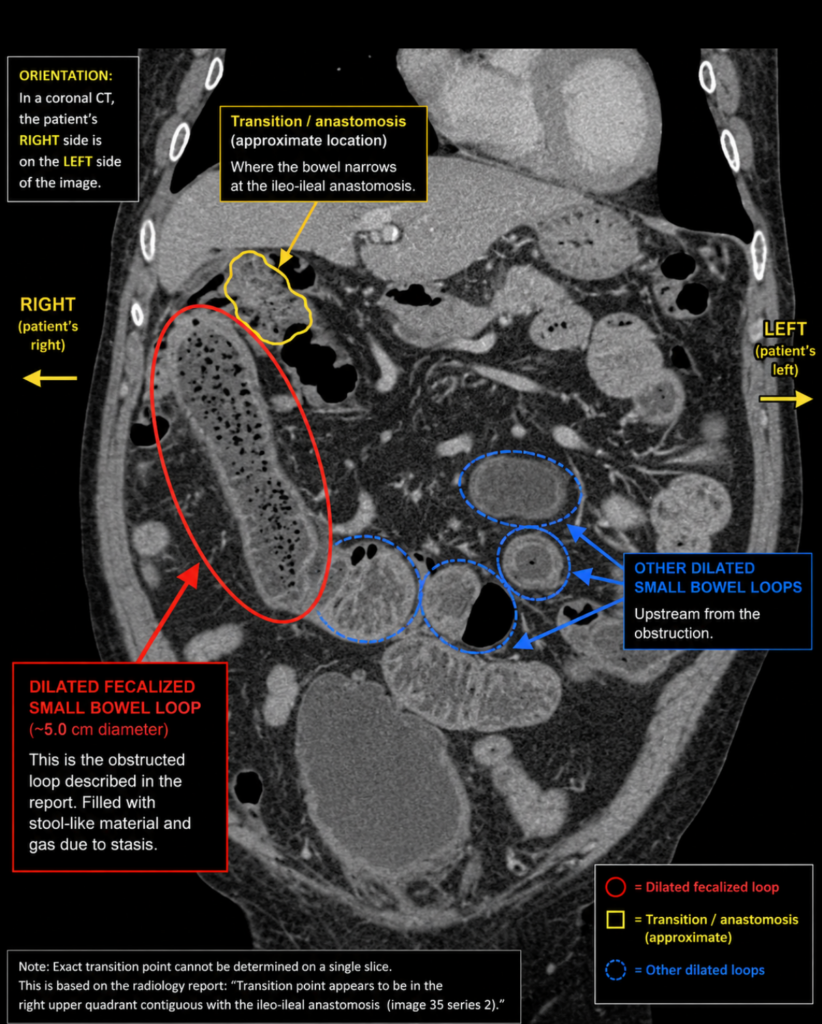
Unlike other medical facility apps I’ve used, the app from Northwell, the company that owns both the ER in Greenwich Village and Lenox Hill Hospital, not only shows the radiology report but also the actual scan images. When I got home, I looked at them, which of course made no sense to me because I don’t know how to read an X-ray, let alone a CT scan. I’ve spoken with doctors who say they have trouble interpreting scans, which is why they’re first reviewed by radiologists.
But I downloaded some of the CT images to my PC and loaded them into ChatGPT, which analyzed them and gave me a report that was pretty close to what the radiologist wrote. But even though both the radiology report and ChatGPT’s interpretation gave me a pretty clear idea of what had happened, I was still curious as to exactly where the blockage was. So, I fed ChatGPT the radiology report and asked it to annotate the image and highlight any significant abnormalities.
It then gave me an annotated version of the CT image with the blockage clearly outlined, along with a couple of other findings and explanations of everything it found. That image was pretty remarkable in that it allowed me, a layperson, to get a good understanding of exactly what had gone wrong. I later showed it to a gastroenterologist, who agreed that ChatGPT got it right.
Returning to NY to Say Goobye to CBS News Radio
I’m fine now and, less than a week after leaving the hospital, I’m returning to New York for the going-away party for CBS News Radio, which is ending its 99-year run. I spent 20 years as the network’s technology analyst and another five as host of the ConnectSafely Report, which CBS distributed to its affiliates until its final day on the air.
The Tiffany Network’s radio service, once home to the work of Edward R. Murrow, Walter Cronkite, and other legendary journalists, is gone as of 11:31 p.m. Friday, May 22.
I’m alive and well, which is more than I can say for CBS News Radio.