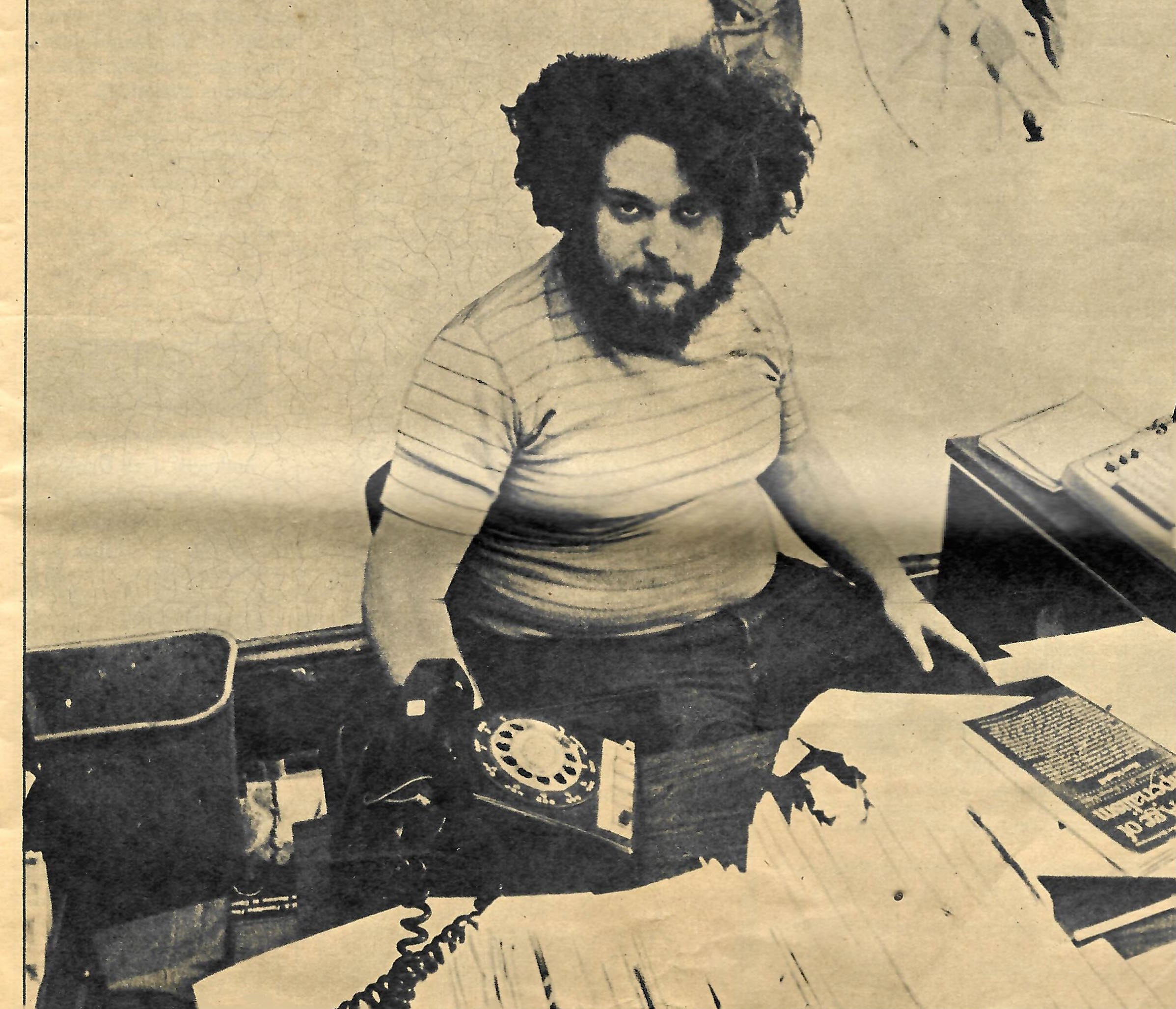
In October, 1970 West Magazine, which was bundled with the Sunday Los Angeles Times, did a profile on me and Dennis Hayes — the founder of Earth Day. It was written by columnist Art Seidenbaum who was a household name in LA. He interviewed me at my office at the National Student Association n Washington DC. Here is the picture that ran as a full page in the magazine and the text of the portion about me. And yes, that’s how I looked. A couple of years later I lost 80 pounds.
Where Are They Now
By Art Seidenbaum
Los Angeles Times Magazine, October 18, 1970
Los Angeles Times Magazine, October 18, 1970
“Larry Magid looks like a cherub, thinks like a militant and writes like a political scientist.
That was my impression at UC Berkeley when Larry was leading the Center for Participant Education and fighting for Eldridge Cleaver’s pedagogical rights. Larry smiled too widely, spoke too softly to terrorize. Even when he grew a wild beard around his winsome cheeks, Magid seemed benign.
He still wears his beard and his paunch and his pullover shirts in Washington. Now he has a receptionist between him and the rest of humanity.
A stone townhouse has been converted into headquarters for the National Student Association. A pretty black girl in bare feet appeared at the front desk and pointed me to NSA’s Center for Educational Reform. Magid’s Center is one large room shared by three people who design experimental college curricula, plan conferences and publish Eccentric, a bi-monthly journal.
Larry often sleeps in the building. He would show me his sleeping space, he said, but the air-conditioner broke down and there’s water all over the floor. Besides, he wasn’t sure that living there is legal; he doesn’t want to get NSA in trouble for having a staff-in.
Magid stays close to the shop. He usually eats lunch at a place called The Dirty, across the street. I asked for something fancier and so we went to the Ghengis Khan instead. The place is white and gold but no one questioned the portly young man in the curly beard and chartreuse shirt.
Larry told me that NSA represents 500 student governments around the country and that it can glue campuses together. After Cambodia, for instance, Charley Palmer put NSA in support of student strikes. “At least 150 schools, especially smaller schools in the South that would not have struck otherwise,” said Magid, “followed the NSA call.”
NSA’s educational stance is to the left of old-fashioned liberalism and a long stride right of revolution. “We can’t be revolutionary,” admitted Magid. “Some schools don’t even see underground newspapers. They get Eccentric and it’s probably the most radical journal they see. We’re not militant touchy-feelies either. I suppose,” and he smiled, “you could say we try to be left moderates and I don’t know how successful we are at it.”
Does it bother him to moderate his own role? “The alternative to this,” said Larry, “might be working in a factory by day and doing politics at night. That’s more pure, I guess. But the people who really bug me are the ones who need $16,000 a year in order to be able to afford being radicals and they won’t budge from the figure. There are a lot of people in their mid-30s running around getting paid to be the voice of youth.”
Larry Magid has had some fun trying to politicize apathetic student bodies and writing articles about educational repression, but running an office can be a lonely business when your girl friend is still at Berkeley and you don’t want to wander in government circles. “Evenings are kind of a drag,” he allowed. “I work, I write. I handle my phone calls to California.
One evening, Magid, Mike Levett, Larry May and I went to dinner. May worked with Mike at the Daily Bruin; now he was a reporter-intern at the Washington Post. We ate at a waterfront seafood place and on the way May started to point out tourist attractions.
“See,” said Magid punching me on the shoulder, “you’re with three Californians and all they can think of is driving you around.”
The night wound down in a bar called the Black Sheep, where the three UC graduates argued the mediocrity of government. Magid said that this country needs a decentralized social-radical
movement. Levett said he was looking for a philosopher-king.
Then suddenly they were talking girls and sports and do-you-know. The last question I can remember was Magid asking, “Whatever happened to Mary Ellen Kleinholz?” I think that was her name.