by Larry Magid
This post first appeared in the Mercury News
By the end of 2024, 79% of adults and 87% of children lived in homes with wireless-only phone service, according to the National Center for Health Statistics. That means the family phone, which was omnipresent in homes when I was young, has largely disappeared from American homes.
Bye-bye traditional landline
My wife and I pulled the plug on our AT&T landline several years ago for three reasons. One is because most incoming calls were either a telemarketer or a scammer. Another was because the call quality had diminished due to static on the line that didn’t go away despite a couple of service visits from AT&T. The third was the cost. I can’t remember what we were paying, but it was more than I was willing to pay for a service that had become nearly unusable.
Still, we missed having that landline for a couple of reasons. One reason became clear when a relative called my wife’s phone just to say hello. He really wanted to say hi to both of us but there was no house phone to call. I jokingly said I was offended, but even though he wanted to speak with both of us, he had to pick one. The good news is that smartphones all have speaker functionality, which wasn’t true with standard house phones growing up. The only way more than one family member could talk with a caller was to pick up an extension, if you had any. The landline also served as a backup in case our cell phones weren’t working or out of reach.
AT&T “Picturephone”
I’m old enough to remember when AT&T showed off the Picturephone at the New York World’s Fair in 1964. While it amazed the public, it was far too expensive, even for business use. Today, every smartphone can make free video calls via WhatsApp on Android and iPhone, or FaceTime on Apple devices. And ever since the pandemic, many of us have been using Zoom and other video conferencing services regularly for both business and personal calls.
An internet “landline”
While I no longer have that AT&T landline, we do have phones in our house that look and work like traditional phones. Instead of calls traveling over copper wires, our Ooma line connects through the internet. Ooma is probably the most affordable option for people who still want a service that functions like a traditional home or office phone.
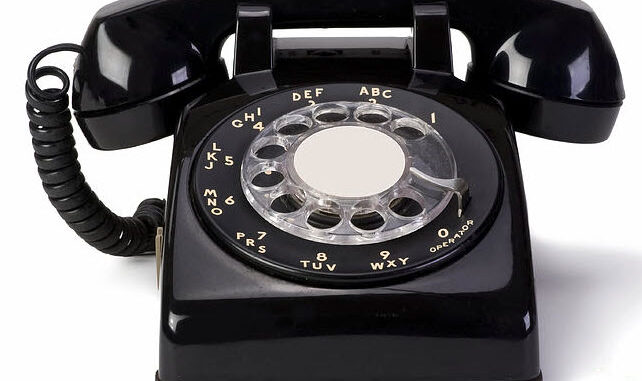
An Ooma system consists of a $79.99 Telo device, about 8 by 6 by 2 inches, that plugs into your internet router or gateway. It has a standard phone jack that works with nearly any telephone, including old-fashioned desk phones and cordless phones. I had a standard two-line phone in my home office that was hardwired to the Telo, but I recently replaced it with $49.99 Ooma HD3 handsets that connect wirelessly to the Telo. Just for fun, I also plugged in an old rotary-dial phone. It works for incoming calls, but not outgoing ones because Ooma requires touch-tone dialing.
There is no charge for basic service other than taxes and fees, which in my area add up to about $7.50 a month. The basic plan includes unlimited calling throughout the U.S. and Canada, the ability to keep your existing phone number, and standard features such as call waiting, call hold, call return, call logs, and international calling at rates that are typically lower than traditional landlines. There’s also a $10-a-month Premier plan with additional features.
If your power to the internet goes out your Ooma phone dies, but there are workarounds. For one, you should still keep your cell phone handy, but you can purchase Ooma’s LTE Adapter ($130 plus $20 a month) that has a backup battery and uses cellular service if your internet connection goes out. I don’t use the LTE adapter, but my Ooma Telo and internet gateway are connected to a battery backup system, and the handsets have batteries.
Phones for kids
The company recently introduced MyPhone for Kids, which lets parents create a “Trusted Circle” so only approved contacts can call, schedule “Quiet Hours” that send calls to voicemail during homework or bedtime, monitor calls online and use address-based 911, which shares your registered address with emergency responders and can alert designated family members. It’s a way to give children a phone, even in their bedroom, without access to a screen, apps and text messaging.
Google Voice
Google has long offered a free service called Google Voice that lets you use a single phone number that can simultaneously ring up to six phones. You can choose an available number, or, for a one-time $20 fee, port your existing number. Google Voice lets you make and receive calls, send and receive texts, and manage voicemail from a web browser or mobile device. It also includes searchable voicemail transcripts, spam filtering, call screening, caller blocking and low-cost international calling
If you have an Android phone, your Google Voice number can appear as your caller ID, even if you use the phone’s built-in dialer. On an iPhone, your Google Voice number appears as your caller ID when you make calls or send texts through the Google Voice app. Ooma also supports displaying your Google Voice number on calls made through its service.
I love that most modern phone services include free calling, but there’s an irony. I could have used that when I was a kid, when my friends and I spent hours talking on the phone. Today, now that calls are essentially free, many people would rather text than talk.