Like many Americans, I was very upset about the events of last week. Although I didn’t agree with his views, I certainly agree that Charlie Kirk not only had the right to express his opinions, but also the right to live and watch his two children grow up. It is truly a tragedy when anyone is murdered, and this is no exception.
Because of his prominent position, and probably because of the controversy surrounding him during life, this became a particularly traumatic moment for many—if not most—Americans. And it’s far from the only recent case of political violence. Just weeks earlier, Minnesota House Speaker Melissa Hortman and her husband were murdered, allegedly by someone with a “hit list” that included several Democratic officials, attorneys, and their families.
In recent years, we’ve also seen an assassination attempt on then-candidate Donald Trump, the brutal assault on Nancy Pelosi’s husband, the firebombing of the Pennsylvania Governor’s mansion, threats against Supreme Court justices, a plot to kidnap Michigan Governor Gretchen Whitmer, and, of course, the January 6th attack that brutalized Capitol Police officers.
Taking a Break from Social Media
Like many people, I spend a lot of time on Facebook and LinkedIn. But after seeing a flood of posts and comments about the murder, I had to turn away from Facebook for a few days and am now on a short break. What I was seeing was triggering me in ways I didn’t like. I’m not taking a break from LinkedIn, a professional network with fewer polarizing posts and comments.
The State of Our Discourse
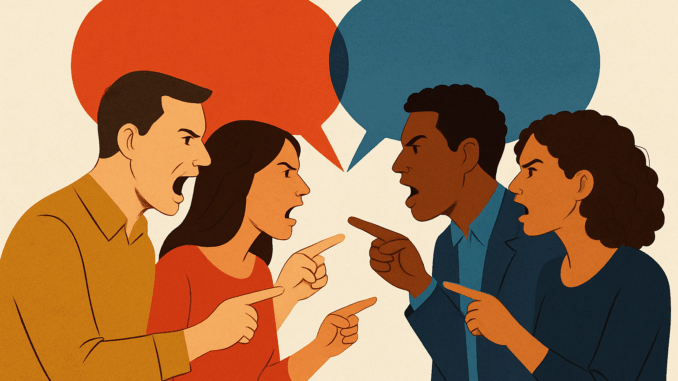
Political discourse is the lifeblood of democracy, and we should continue to have vibrant discussions—agreeing, disagreeing, and ultimately coming to conclusion through the ballot box. But what we have right now are shouting matches on social media, cable TV and other forums, where people hurl words at each other.
In the immediate aftermath of Kirk’s assassination, reports spread about who did it, what motivated them, and who might have inspired it. All were conjectured, and many meant to be inflammatory, making some people feel more unsafe.
Some even claimed the shooter was transgender, based on the initials TRN on the bullet casing—later revealed to be the mark of Turan Ammunition, a Turkish company. Aspersions based on sexual identity, race, ethnicity, immigration status or any other general characteristics are bigoted and often wrong. For example, research shows that immigrants are less likely to commit violent crimes than native-born Americans, while LGBTQ+ people are far more likely to be victims of violent crime than straight, cisgender Americans.
We Need to Tone Things Down
At this writing, we don’t know a lot about what motivated the young man who allegedly pulled the trigger, though Utah Governor Cox said on Meet the Press that he is a “very normal young man” who had been “radicalized” online,” not unlike other shooters who had been influenced by extremist rhetoric from the right and the left.
. But one thing I do know is that we need to live together as a society. We need to take a deep breath and figure out where we as a country are going.
Free Speech and Civility Can Co-Exist
As a tech writer and CEO of ConnectSafely, I’ve long been a champion of free speech and forums where people can express themselves. Even in my earliest writings about online safety, I argued for protecting kids while ensuring adults had free access to all legal media.
But I also believe in civility and honesty. You can express your opinions without insulting other people, calling them names, or spreading false information.
Section 230 in the Age of Algorithms
For years, I supported Section 230, the portion of the Communications Decency Act that shields platforms from liability for what users post. But things have changed. Online services are no longer just forums where anyone can grab a soapbox. They’ve become publishers in practice, because algorithms amplify and selectively distribute content.
I don’t blame Meta, TikTok, Snap, or any other service for the fact that some users post incendiary or false comments. That’s free speech. What concerns me is when their algorithms amplify those comments, ensuring they reach more people and fueling divisiveness to keep users engaged longer. A research study reported in the journal Science noted, “Outrage is highly engaging and need not be accurate to achieve its communicative goals,” adding “misinformation sources evoke more outrage than do trustworthy sources.”
There is also financial incentive for influencers to speculate and blame. “Posting ragebait and speculation in these moments can be very lucrative,” Renee DiResta told CNN’s Oliver Darcy.
Going back to the town square analogy: you wouldn’t blame the mayor if someone shouted incendiary remarks. But what if the mayor handed them a bigger megaphone and rallied citizens to listen? That’s pretty much what social media companies are doing when algorithms amplify hateful or inaccurate content.
Social Media’s Promise and Peril
A modification of Section 230 wouldn’t solve everything, but it might remove excuses critics use to condemn social media. By and large, I still see social media as a positive force. Billions of people, including many young people, use Snapchat, Instagram, Discord, YouTube, TikTok, and other platforms to express themselves, organize for causes, and overcome isolation. None of this is a condemnation of the mission of social media. But we do need to stop rewarding incendiary commentary.
Leadership and Responsibility
Not all blame lies with platforms. Much of it goes to our leaders, who model bad behavior—sometimes using their pulpits not just to criticize opponents, but to demonize and dehumanize. Words like “vermin” and “scum” have no place in national discourse, especially when aimed at well-meaning people exercising their right to help shape America’s future.
But when it comes to this specific crime, I agree with Utah Governor Spencer Cox, who said: “Only one person is responsible for what happened.” At the same time, he warned, “The problem with political violence is it metastasizes, because we can always point the finger at the other side. And at some point we have to find an off-ramp, or it’s going to get much, much worse.”
Peaceful Expression Matters
Charlie Kirk was murdered while interacting with students on a university campus. While I don’t agree with what he said, that rally was an appropriate way for him to reinforce the views of supporters and attempt to persuade skeptics. Peaceful gatherings like that—whether we agree with the message or not—are legitimate and important ways Americans express themselves and shape public opinion. It’s disturbing that other political figures, including Alexandria Ocasio-Cortez, have had to cancel events because of safety concerns.
Whatever your feelings about Donald Trump, Democrats, Republicans, or Charlie Kirk, it’s incumbent on us to find peaceful ways to express them. That includes rallies like Kirk’s, demonstrations like No Kings Day, and nonviolent civil disobedience as practiced by Martin Luther King and Mahatma Gandhi.
Toward Respectful Conversation
We should all pay attention to each other’s messages. You can respond and disagree but, be kind and respectful and try to learn something from people you disagree with by asking questions and engaging in conversation rather than hurling insults. If you disagree, explain why—don’t call them a name. Labels like “communist” or “fascist” are designed not to educate but to inflame.
Find ways to frame criticism that might actually persuade rather than insult. What we need is conversation, not degradation.
Children Are Watching
Finally, I want to talk about children. They are watching, listening, and reading. One of the most disturbing aspects of the Kirk incident was that reportedly gruesome videos—thankfully I haven’t seen them—were circulated online, exposing many children and teens to horrific images. You can’t unsee something like that. It’s hard enough for adults; for kids it’s devastating.
I urge all media, social and broadcast, to find ways to describe horrors without graphically illustrating them. Outrage and activism can be inspired through words or carefully edited images, without subjecting people to gore.
For parents whose children or teens have seen this or other upsetting content online, the Children’s Hospital of Philadelphia offers useful guidance: Tips for Parents on Talking to Children Exposed to Violent Events.
And I want to beg everyone not only to physically hug your children and other loved ones, but metaphorically hug the people you interact with online. We can all use some compassion, love and reassurance.
Disclosure: Larry Magid is CEO of ConnectSafely which received financial support from some of the companies mentioned in this article.