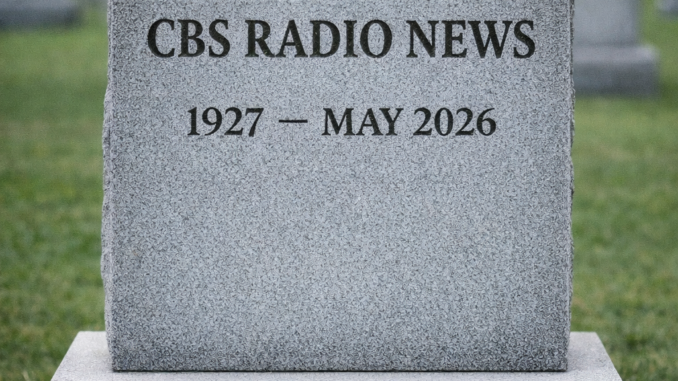
I am sad and angry about the decision to pull the plug onCBS News Radio after nearly 100 years.
I have been privileged to be associated with that legendary organization for several decades. It started informally during the 1980s and early 1990s when I wrote a syndicated tech column for the Los Angeles Times, which, at its height, ran in about 70 papers including the Washington Post. During that period, I was a frequent unpaid guest on the CBS network and many of its stations along with competing TV and radio outlets. I was also a regular guest on KGO San Francisco and KABC Los Angeles and a commentator on NPR’s All Things Considered.
Then, around 1995, CBS’s owned and operated San Francisco station, KCBS, hired me to do a live Q&A segment two afternoons a week. That quickly expanded to five days a week and I remained in that time slot for nearly a quarter of a century, until late 2019. Even though my work for KCBS was very part-time, I was an employee and a member of the TV and radio artists union, now known as SAG-AFTRA. In the late 90s I was also hired by the CBS-owned Los Angeles station, KNX, where I also did daily segments, sometimes lasting as long as an hour.
Because of my part-time jobs with KCBS and KNX, I no longer did interviews with stations from competing networks but would frequently take calls from CBS Radio News (as it was called then), sometimes late at night or early in the morning. At one point, in 1999, my wife suggested that maybe the network should pay me. That seemed like an unlikely dream, but I ran it by a colleague at KCBS who put me in touch with Charlie Kaye, who was CBS Radio News’ executive producer. Charlie was headed to Comdex in Las Vegas that fall and we agreed to meet there. Charlie, who is now a dear friend, connected me with his bosses Constance Lloyd and Harvey Nagler and I was offered a paid part-time position as their “computer” contributor, which later evolved to Technology Analyst. My first stories for CBS included the Microsoft antitrust trial and the “millennium bug.”
Early in my tenure the network provided me with an ISDN line and a $4,500 device called RoadRunner, which enabled me to do live or recorded broadcasts for the network or any local radio stations at broadcast quality, long before that was possible via the Internet. I used that device for more than 20 years and eventually donated it to the Computer History Museum as an example of a now irrelevant but once essential broadcasting tool.
My relationship with the CBS network continued to grow. I started doing “two-ways” with stations across the country and developed friendships with anchors from many of its stations including WTOP News in Washington, WCBS in New York, KFGO 790 AM in Fargo, 100.1 KDKA in Pittsburgh, KLAS in Las Vegas, WCCM in Uniontown, PA, and many others. I still speak with some of those stations.
At some point, I was asked to record a daily one-minute segment called Eye on Tech for CBS’s streaming service and for broadcast on many of its 700 stations, reaching an audience in the millions. In 2019 I became an actual employee. Someone in their press office put out a release mistakenly calling it a “full-time position,” but I was part time because I was also working full time as CEO of ConnectSafely and continuing to write my weekly tech column for the Mercury News. Still, I loved working for CBS News and there were days when I was on the from pre-dawn till midnight, covering major tech stories.
My daily Eye on Tech show, along with my two-ways and frequent sound bites for the hourly news and the CBS News Roundup, continued until May of 2020 when, along with numerous other CBS News employees, I was laid off in the midst of the pandemic. I was lucky to have lasted that long. Many of my colleagues had been let go in earlier layoffs. It was already a tough time for broadcast news and it’s even tougher now.
I was sad about the layoff, but I wasn’t angry. Craig Swagler, who had taken over from the legendary Harvey Nagler as head of radio news, had no other choice. But I was able to turn “lemons into lemonade” by pitching Craig on a new twice weekly feature called “The ConnectSafely Report,” which would be produced by my full-time employer, ConnectSafely, the non-profit internet safety organization where I serve as CEO.
I was happy about the new role. What I cared about wasn’t the money CBS had paid me but the joy and honor of getting to speak with millions of people in their homes, cars, and headphones and the relationships I had developed with fellow journalists at the network and the affiliates. Besides, after I posted on Facebook about the CBS layoff, I was offered a segment with BBC News, another legendary broadcaster that I was honored to work with.
I don’t know the future of the ConnectSafely Report, but until they pull the plug in March it will continue to be made available to the 700 CBS News Radio affiliates and all the major podcasting platforms as we look for a new broadcast home for the program.
As I think about my relationship with CBS News, I realize that it didn’t begin in the 1980s but in the 1950s when, as a boy, I watched Walter Cronkite on TV and listened to CBS News on the radio. Even before they became colleagues and friends, I was very familiar with legendary broadcasters such as Dan Raviv, Howard Arenstein, and the now departed Christopher Glenn and Douglas Dow.
The loss of CBS News Radio is deeply sad, but life goes on. I will forever be grateful for the opportunity to be part of this incredible institution. It’s been a dream fulfilled.